
Discavia Systems
Developing new aerospace capabilities for a changing security environment.
01 — Security Environment
The Security Environment Has Changed
The nature of warfare has undergone a fundamental transformation. Conflicts across the globe have demonstrated that the character of modern warfare is evolving at a pace that outstrips the adaptation cycles of traditional defence procurement and doctrine.
The Revolution in Military Affairs — long theorised in strategic studies — is now a lived operational reality. Precision, speed, and autonomy have become decisive factors on the battlefield. The proliferation of unmanned systems has shifted the balance of power in ways that were, until recently, confined to academic debate.
State and non-state actors alike are leveraging commercially available and purpose-built unmanned aerial systems to achieve effects that previously required significant conventional force. The threshold for precision strike capability has dropped dramatically, while the cost of fielding effective aerial systems continues to fall.
European defence establishments face an urgent requirement to develop indigenous capabilities that are not dependent on external supply chains, that can be rapidly adapted to evolving threats, and that are designed from the outset for the operational environments of the next decade — not the last one.
02 — Capability Development
From Operational Environment to Capability
Discavia Systems approaches capability development by beginning with a rigorous analysis of the operational environment. We do not design systems in isolation from the conditions in which they will be employed. Every design decision is traceable to a specific operational requirement, threat characteristic, or environmental constraint.
This methodology requires close engagement with operational users, intelligence assessments, and lessons emerging from active conflict zones. It demands intellectual honesty about the limitations of existing systems and the willingness to pursue unconventional solutions when conventional approaches are insufficient.
The result is a capability development process that is grounded in operational reality rather than technological possibility alone. We build what is needed, not merely what is technically achievable.
Capability is not defined by what a system can do in ideal conditions — it is defined by what it can reliably achieve in the conditions that actually exist.
03 — Development Philosophy
Effect-Centric Development
"Anticipate the operational environment rather than simply respond to it."
— Discavia Systems Design Principle
Effect-centric development means that the desired operational effect — the outcome we need to achieve in the field — is the primary design driver. Technical specifications, performance parameters, and system architecture are all derived from this starting point.
This approach stands in contrast to technology-push development, where a technical capability is developed and then a use case is sought. Effect-centric development is inherently demand-pull: the operational requirement comes first, and the engineering solution follows.
Discavia applies this principle across all phases of development — from initial concept through to industrialisation. It requires a continuous feedback loop between operational users, systems engineers, and manufacturing specialists. It demands that we remain willing to revise our assumptions as the operational environment evolves.
The goal is not to produce the most technically sophisticated system, but to produce the most operationally effective one — a system that delivers the required effect reliably, at acceptable cost, and at the scale that operational requirements demand.
04 — Systems
High-Speed Unmanned Systems
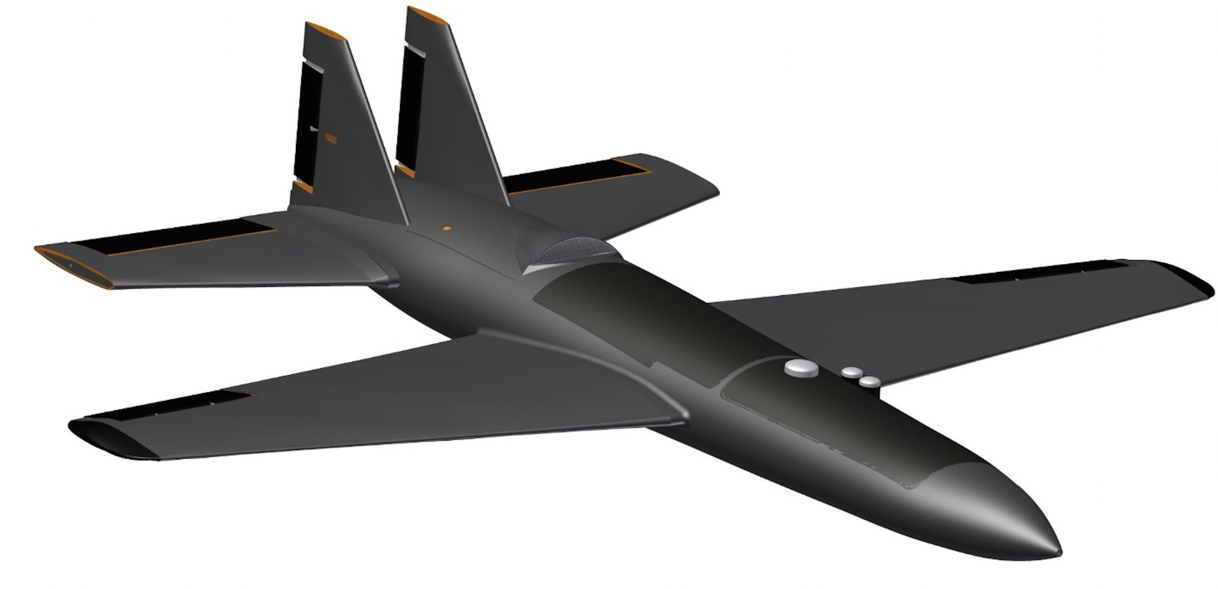
Discavia Systems is developing a family of high-speed unmanned aerial systems optimised for the operational environments identified through our effect-centric development process. Our systems are designed to operate in contested airspace, against adversaries equipped with modern air defence capabilities.
Speed is a fundamental design parameter. High-speed systems compress the decision cycle available to adversary air defences, reduce vulnerability to interception, and enable time-sensitive targeting in dynamic operational environments.
Our development programme draws on the operational experience of Ukrainian and international aerospace and defence specialists who have direct, current knowledge of the systems and tactics being employed in active conflict. This is not theoretical — it is grounded in what is actually working, and what is not, in the field today.
05 — Team
Team
Discavia Systems brings together Ukrainian and international specialists with direct experience in aerospace engineering, defence systems development, and operational deployment of unmanned systems in active conflict environments.
Our Ukrainian team members bring irreplaceable operational insight. They have observed, analysed, and in many cases directly participated in the development and deployment of unmanned systems under real combat conditions. This experience is not available from any other source — it cannot be replicated in a laboratory or derived from historical case studies.
Our international team members contribute expertise in aerospace engineering, systems integration, industrialisation, and the European defence procurement environment. Together, the team combines operational urgency with engineering rigour and industrial capability.
Discavia Systems is registered in Estonia — a NATO member state with a strong tradition of defence innovation and a deep understanding of the security challenges facing the European continent.
06 — Engineering
Engineering & Industrialisation
Discavia Systems is committed to the full engineering and industrialisation cycle — from concept and prototype through to series production. We recognise that a system that cannot be produced at scale, at acceptable cost, and with acceptable quality is not a viable defence capability.
Our industrialisation approach is designed to support rapid scaling. We prioritise designs that can be manufactured using available industrial capacity, with supply chains that are resilient to disruption and not dependent on single-source components or geographically concentrated production.
We are actively developing partnerships with European manufacturing partners to ensure that our systems can be produced at the volumes required to meet operational demand. This is not a future aspiration — it is a current programme requirement that shapes our engineering decisions from the earliest design stages.
07 — Partnerships
Partnerships
Discavia Systems is actively seeking partnerships with organisations that share our commitment to developing effective, affordable, and rapidly deployable unmanned aerial capabilities for European defence.
We are open to cooperation across the full spectrum of the development and production cycle, and we welcome engagement from defence ministries, procurement agencies, research institutions, and industrial partners.
Areas of Cooperation
Joint development and co-design of unmanned aerial systems
Technology transfer and licensing arrangements
Manufacturing and industrialisation partnerships
Systems integration and testing
Operational evaluation and user feedback programmes
Research and development collaboration
Defence procurement and acquisition support
Training and capability development